The great appeal about the card game Piquet (which can be pronounced either P.K. or ‘picket’) is that, unlike most games of cards, the element of declaration and the possibility of exchanging cards with a stock pile, means it is possible to have a very good idea of the cards in your opponent’s hand. This turns Piquet from a game of pure chance into one with far more intellectual rigour. Chance might dictate the original fall of the cards in each hand, but the individual player’s skill determines the play. It is this element of the game that made it popular for the best part of four centuries.
Piquet first appeared around 1500, and it was then universally called some version of ‘cent’ as the aim of the original game was to be the first to 100 points. In England, this meant it was usually known as Saunt, Saint and oddly, by the early 17th century, sometimes with the prefix ‘mount’, hence appearing as ‘Mount-Saint’ or ‘Mount-Cent’. It became known as Piquet only towards the middle of that century. Cavendish, writing in the 19th century, suggests this was due to the arrival of Queen Henrietta Maria, who brought the French version of the game and its name with her.
There is some debate as to where Piquet began. As it became France’s national game, the French naturally enough lay claim to it and have a number of charming myths surrounding its origins. However, Spain or Italy are today considered more likely. It is hard to be sure since ‘cent’ is one hundred in Latin, and Latin was the universal language of educated Europe at the time. But, whatever was its nation of origin, over the course of the Sixteenth Century, the game gained impetus and popularity, spreading across the continent.
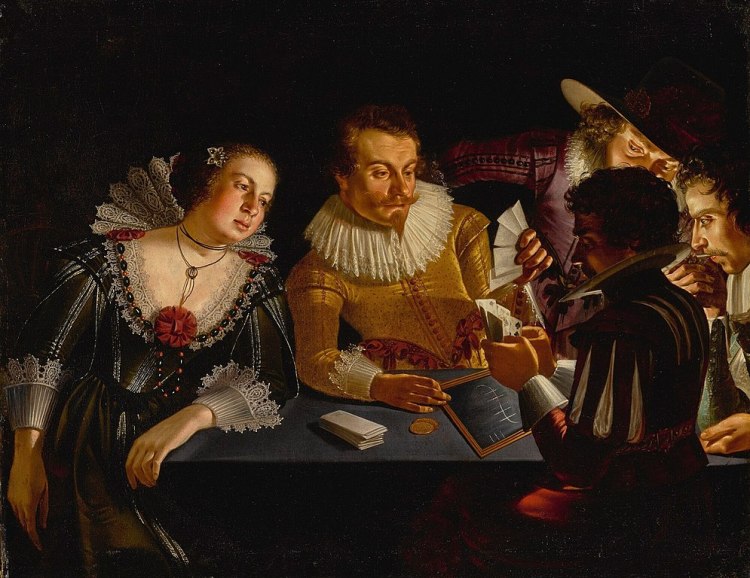
Groups of people playing and/or watching a game of cards was a popular subject for artists in the 17th century.
The first description of Piquet is in a German account written in 1620 by one Gustavus Selenus. This was the pseudonym of Augustus, the younger son of Henry III, Duke of Brunswick-Lüneburg and a member of the noble House of Welf. As well as writing about Piquet and penning a treatise on chess, Augustus was fascinated by cryptography and wrote a book on it in 1624, which was largely based on Trithemius’ works, including Steganographia a book which features in my story Fortuna’s Fool about which more below. Augustus went on to become Duke of Brunswick-Lüneburg following the death of Frederick Ulrich (a man we meet in one of my Lord’s Learning books, The Soldier’s Stand) in 1634. In his account of Piquet, Gustavus/Augustus described the game with most of the key features already in place.
The first book in English to give the rules was published in 1651. It claimed to be a translation of an earlier French work and was called The royall and delightfull game of picquet. The author was anonymous, but the text declared it was Printed for J. Martin, and J. Ridley, and was to be sold at the Castle in Fleet-street nere Ram-Alley.
Piquet was played with a deck of thirty-six cards (from six up), and the ace was ranked above the king. The advantage in every hand played went to the non-dealer (Elder), not the dealer (Younger). After cutting for the deal, the Younger would give each player twelve cards (dealing two to four cards each time), and the remaining cards would be placed in a stack (talon). Then the Elder could exchange up to seven cards with those in the talon, before the Younger could exchange with as many as were left.
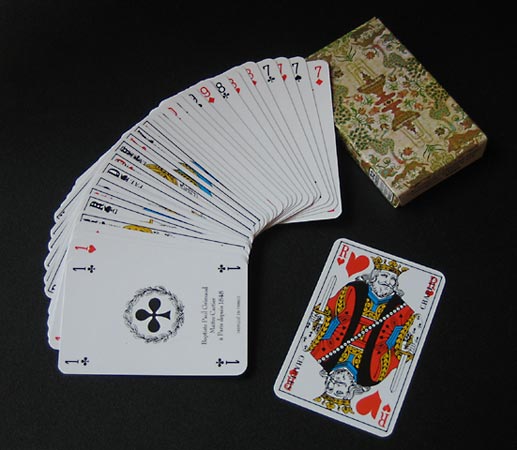
After this, there would be a declaration stage where each player (Elder first, and then the Younger) would announce if they had any sequences and sets in their hands, and score points for them before the game was played. The Elder hand would then lead, and each lead would score a point, as would winning the trick, and an extra point was awarded for winning the final trick. The game would end when someone reached a hundred points or after a certain number of hands had been played, with the winner being the one with the highest score at that point.
As with all card games, especially in an era where writing such things down was still almost unknown, the rules would frequently have had such minor differences. Local variations, house rules and, of course, individual preferences all contributed. Some of these variations would have been more widely adopted and eventually entered the mainstream gameplay, whilst others were discarded over time. Even when books detailing the rules began to appear, the game continued to evolve. In the modern game, for example, the deck is smaller than that described in the older sets of rules – something that was likely born from a variation played long before it was standardised.
Interestingly, the decline of Piquet roughly corresponds to the rise of Contract Bridge, and books like that by Cavendish share affinity with many later books on Bridge in style and devotion to technical detail. This is perhaps not surprising as the two games would have appealed to the same kind of card player, and the added complexity (not to mention the additional social opportunity) of having four players and partnership bidding in Bridge quickly won out over the simpler, two-player Piquet.
Here is a brief extract featuring the game of Piquet from Fortuna’s Fool, a short story I wrote that appears in The Ring, a charity anthology of historical fiction stories which comes out on Kindle on 1 May. All the stories feature the same Roman-era ring as it progresses through time, from Julius Caesar up to the present day, influencing the lives of those it comes into contact with for good or ill. Fortuna’s Fool is set in September 1633, at the Siege of Nancy in Lorraine, as Danny Bristow is just starting his military career.
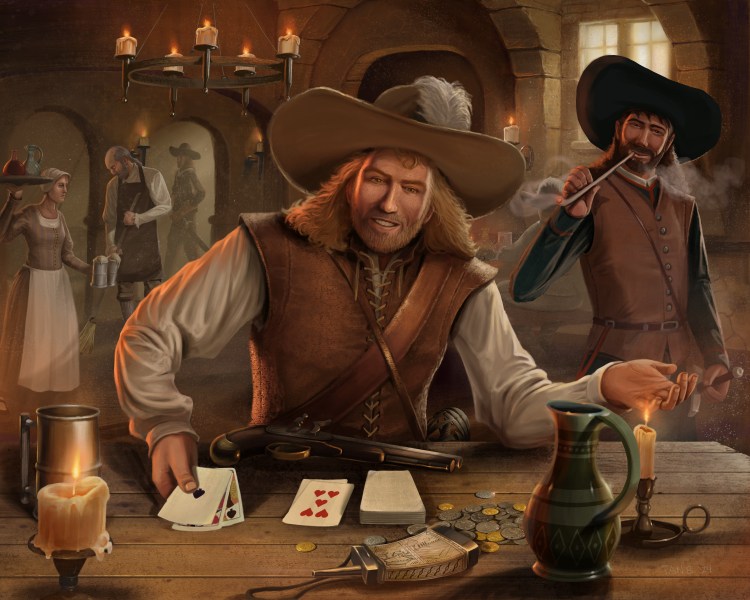
The small pool of light provided by the candle at his table illuminated the cards in play and the face of Danny’s opponent, who was frowning at his cards as if trying to decipher them. It was that face Danny watched. His own cards he held folded, not fanned, the edge of them pressed into his palm and fingers, his knuckles resting on the rough wood of the table. He knew what the cards were and had no need to remind himself. Besides, the men clustered about the table, intent on the game, were not his friends and allies but those of the man who sat opposite. A glance of his hand from one of them would be enough to betray the bluff he was making.
Bluffing in Piquet was an art all of its own and one in which he knew he excelled. For Danny, who loved the thrill of gambling, it was the headiest nectar, because in Piquet, your bluff would always be called. It wasn’t enough to convince your opponent that you held whatever card or cards you wanted them to believe in. No, you had also to bring them to play the cards you needed them to play so the cards you actually held became winners. He’d said those exact words the previous day, having beaten Captain Rider at a hand or two. The captain had nodded sagely, his look the one he so often seemed to wear when he talked to Danny. His ‘I’m more than twice as old as you and one day you’ll understand’ look that made Danny want to roll his eyes heavenwards. But of course, he never did. Captain Rider was his employer after all.
“You need to be careful who you do that with,” the captain told him. “Few men mind being beaten fairly in a gambling game, but no one likes to be taken for a fool—and that’s what you’re doing. The wrong time, the wrong man and you’ll find it’s your skill with a sword that’s being tested, not your skill with cards.”

As well as my Fortuna’s Fool, The Ring features stories from, Alistair Forrest, Fiona Forsyth, Jacquie Rogers, Alistair Tosh, Graham Brack, Mark Turnbull, Maggie Richell-Davies, Robert Bordas and Val Penny. The cover was designed and donated by Ian Bristow.
The Ring is now available to preorder on Kindle and will be out both on Kindle and as a paperback from 1 May. All proceeds will go to The Reading Agency.
To be sure not to miss all the news on this and my other projects, you can sign up for my newsletter here and receive a free Lord’s Legacy short story.
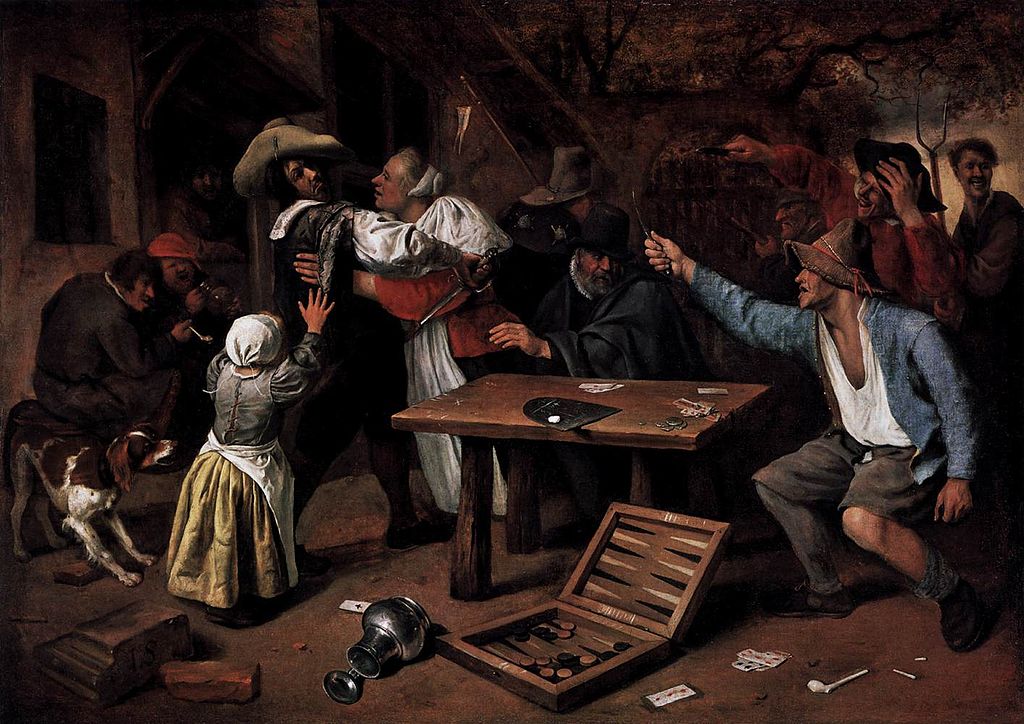
The title painting is ‘Argument over a Card Game’, Jan Steen (1625/26–1679) in the Gemäldegalerie collection, from Wikimedia.
 Eleanor Swift-Hook

