A man around whom legends have been woven in his own dramatic lifetime.
Even when we meet him as a boy of fifteen in Lord’s Learning, it seems shadows are looming behind him. Condemned as a traitor to King James and forced into exile as a result. Those shadows run ever deeper and darker as we follow him being a mercenary on bloody battlefields and as a privateer scouring the Narrow Seas and the Mediterranean. Grasping shadows which threaten to engulf him and all in his company. Shadows of a century-old conspiracy whose far-reaching tendrils still have power and influence.

Original art by Ian Bristow
When he meets Gideon in a lowly alehouse in County Durham, he is a mercenary commander, known as the Schiavono to his men, perhaps after the sword he wears, which is a Schiavona with its distinctive basket hilt and cat’s head pommel.
He has come back to England at this time as it falls into chaos.
He has come back with some purpose.
But what purpose is not clear.
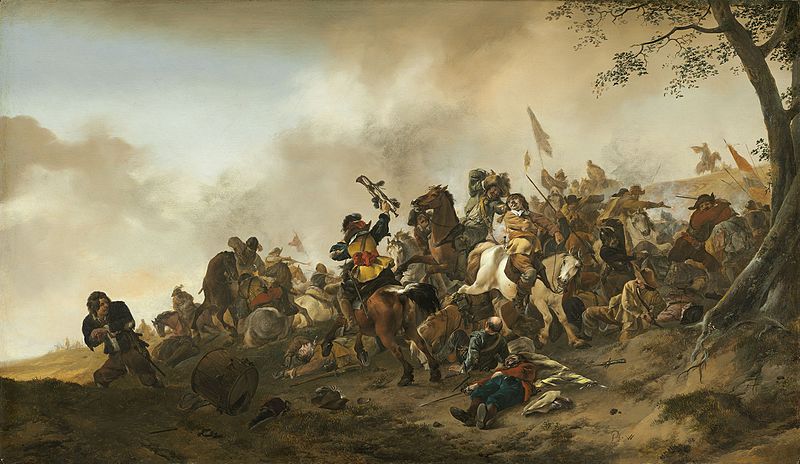
Philips Wouwerman, Public domain, via Wikimedia Commons
Is it to take advantage of the opportunities for pillage and plunder offered in a new theatre of war? To bring the brutality and bloodshed that has been engulfing most of Europe for the last quarter century, to the prosperous and peaceful communities of England?
The chessboard is being set up as the drums of war quicken their beat. Is Philip Lord indeed the powerful knight he seems to be, or is he in truth being played as a pawn in another’s game?

Original art by Ian Bristow
 Eleanor Swift-Hook
