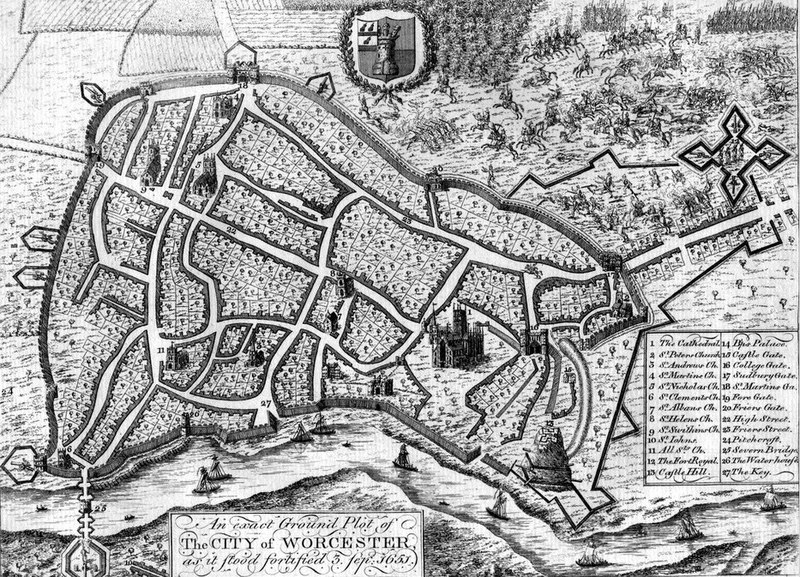
The siege of Worcester took place 29 – 31 May 1623.
Dudd Dudley was a real person who was indeed General of Ordnance for Prince Maurice and may well have been responsible for modernising the defences of Worcester, although I am not sure if he was in the city at the time of this siege or not. He seems to have been a larger-than-life character, overconfident and far from risk-averse, whose schemes often didn’t work out, but I probably do him something of a disservice in the pages of this book.
I don’t know for sure that the women of Worcester were active on the walls with the men before and during the siege, but it seems very likely they were as some were reported killed during the siege and at the end of June they were said to have gone out organised like troops and flattened the siegeworks raised by Waller’s men to make it harder if he should return.
Dr Threadway Nash – No Treadway Nash, Public domain, via Wikimedia Commons
The Kelleys were born in Worcester, and little is known of their origins beyond the fact that their father was called Patrick Kelley. Once Thomas left John Dee’s purview he seems to drop from historical sight and their sister Elizabeth (or Lydia) likewise. Katherine Dee equally vanishes from history shortly after her father’s death.
John Dee had a daughter called Madinia, about which little is known except the date of her baptism in February 1590. She too vanishes from the historical record and has always been assumed to have perished along with her mother and some other siblings in an outbreak of plague in Manchester in 1605.
Fulke Greville, Lord Brooke, is a man about whom a number of myths have been spun. He is probably most famous for his ‘Life of Philip Sydney’ but he was also a poet and even wrote a play. He is claimed by some to have been a leading Rosicrucian, (perhaps even their first Grand Master and the founder of Freemasonry) and by others to have been Shakespeare (and by some to have been both). He was phenomenally wealthy and much involved in politics throughout most of his life.

Elisa.rolle, CC BY-SA 4.0, via Wikimedia Commons
He had a magnificent tomb built in the Collegiate Church of St Mary in Warwick which cost a small fortune to construct and on it had placed the words ‘Folk Grevill Servant to Queene Elizabeth Counsellor to King James Friend to Sir Philip Sidney. Trophaeum Peccati.‘ There have been claims made that radar investigations have shown the tomb contains boxes which purportedly hold proof of his Shakespearean writing—or perhaps some other secret documents.
 Eleanor Swift-Hook

