Some interesting things about the book…
The Mardyck channel was most decidedly a ‘miracle’ for Dunkirk.
There were sandbanks outside the port that made access to the harbour treacherous, especially for larger vessels. In 1615 a fleet of fourteen merchant ships carrying recruits from Spain to the Netherlands were badly damaged by encountering the sandbanks and their flagship was lost trying to get into the harbour. This was not the only such example.
Then in 1621, a previously unknown channel was discovered which went behind the biggest sandbank, close to the coast, and could allow safe passage for all but the very largest ships.

Atlas van Loon, 1649. Sebastien de Beaulieu (designer), Joan Blaeu (publisher)
Wikimedia Commons
It was a game-changer for Dunkirk. The Mardyck Fort was swiftly built to defend the entrance to the channel and by the end of the decade a strongly built, state-of-the-art, fort gave complete artillery cover to ships in the channel.
***
Fisher’s Folly was indeed a real house.
It was built by a man named Jasper Fisher who was either a clerk in Chancery or a member of the Goldsmiths’ company, according to my research, but even if he was relatively well off he was not a man of great status or sufficient means to build “a large and beautifull house with Gardens of pleasure, bowling Alleys and sumptuously builded” as John Stow described it. The cost led to Jasper Fisher’s financial ruin by the time he died and his house being given its intreguing epithet.

Author unknown Wikimedia Commons
***
One of the women who Kate is much involved with in this book is Lucy Harington-Russell, Countess of Bedford.
Lucy was born in 1681 and married at 13, she had her first miscarriage before she was 15 and she never had any children who survived infancy. Her husband had been fined for involvement in Essex’s rebellion and was severely injured in a fall from his horse in 1613 after which he remained housebound although this didn’t seem to impact Lucy’s own career.
She was the daughter of John Harington, who King James I/VI created 1st Baron Harington at his coronation and promptly entrusted with the care of his daughter, Princess Elizabeth. Although by then Lucy had already married, she was close to the princess all her life.
Lucy was incredibly well-educated for a woman of her era and was an active part of the artistic and academic group that revolved around the Sidneys and the (eventually rebellious) Earl of Essex. When Queen Elizabeth died, rather than attend her funeral, Lucy and her mother rode north. On being presented to the new queen, she was made a Lady of the Bedchamber.
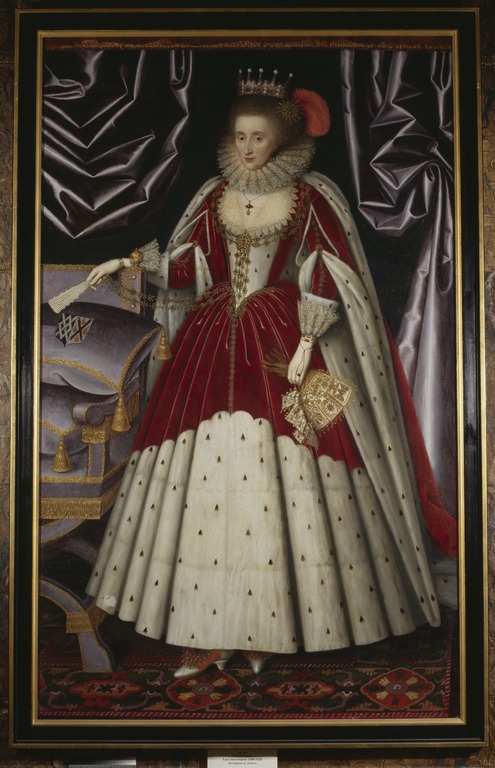
Artist unknown (manner of William Larkin)
Nationalmuseum Sweden Wikimedia Commons
Passionate about masques, court performances which involved grand displays, theatrical and operatic elements – and dancing, usually with audience participation – Lucy performed in several and produced two herself. She collected art, was part of the movement developing the new model of country houses and their gardens, was a huge patron of the arts as many dedications to her show, but most notably she was a major patron of John Donne and Ben Jonson.
She was also politically influential and it is worth noting she was the only countess present when George Villiers was created Viscount Buckingham. But after the queen died in 1619 her own health began to decline. She contracted smallpox that year, which left her blind in one eye. Perhaps as a result of that and the death of her mother the following March, suffered what we would call severe depression. At that point she was the only surviving member of her immediate family, both her parents and siblings having died. Despite that, she rallied and whilst not active as she had been, was still a figure of note at the Jacobean court in 1624.
***
 Eleanor Swift-Hook