
Many of the events in The Soldier’s Stand are historical and the broad sweep of events including the course of the battle of Lutter happened pretty much as I recount it. Although of course Matthew Rider and all his company are my own creation, as are the Gerst brothers and Adam Zajíc (more on Karlo Kadlec later), the army they marched with was very real.
Wallenstein had been an insignificant Bohemian noble a few years before. But after the Battle of White Mountain he was rewarded for his part in reclaiming the kingdom for the emperor with tracts of confiscated land from rebel Protestants, to which he added by buying up more from those who were then forced to leave. By 1625 Wallenstein was Duke of Friedland and in June that year received permission to recruit, thus providing the emperor with what he wanted most – an independent army – and making his name with the decisive victory at the Battle of Dessau Bridge.
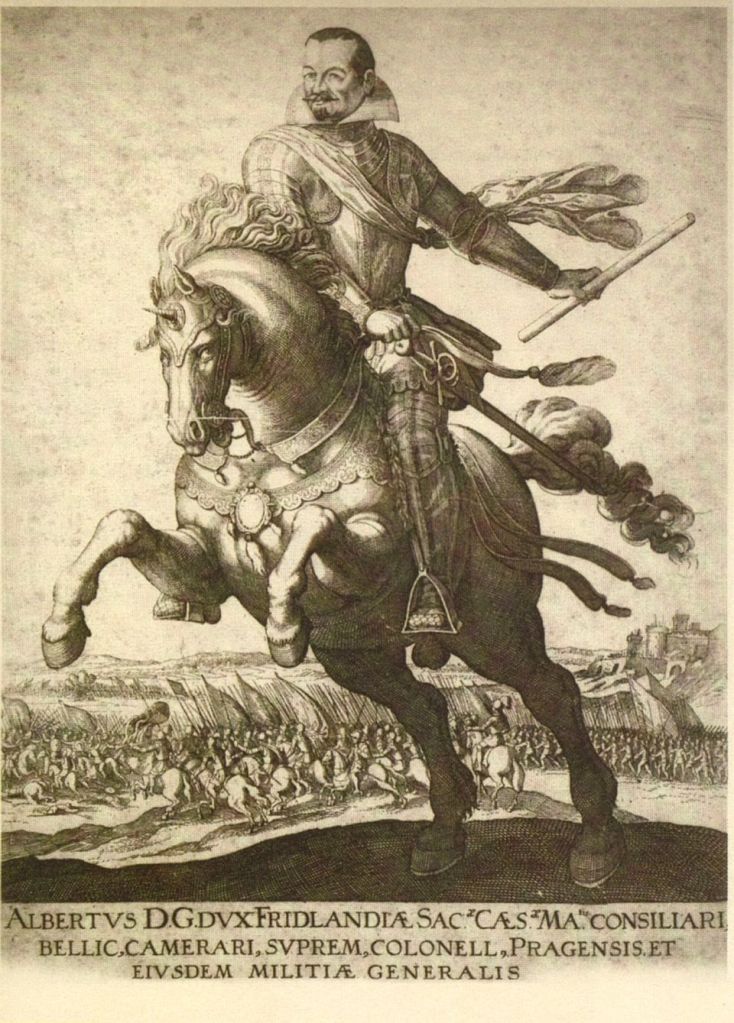
Unknown Engraver vis Wikimedia Commons
The Danish intervention in the war was in support of the dispossessed Elector Palatine. King Christian IV was uncle to his wife and had promises of support from her brother (his nephew) King Charles of England as well as a broad anti-Habsburg coalition which, nominally at least included France, Sweden and even Venice. At first it went well and together with Mansfeld and men like Christian of Brunswick, the Protestant cause briefly flourished. But after the defeat of Mansfeld at Dessau the tide began to turn.
The big advantage King Christian IV of Denmark had was that he was financially very well off. Denmark at this time included Norway, which gave the Danish king the ability to tax shipping passing into and out of the Baltic. These Sound Dues made the Danish monarchy one of the few in the era that was independently wealthy and able to fund a war in his own right. When King Christian marched into the empire he took chests of gold with him. Unfortunately that was ultimately a large part in his undoing as when the fortunes of war turned against him, he refused to abandon the unwieldy baggage train that carried his wealth. Indeed it even appears that when the battle of Lutter began, far from being with his troops and commanding his army, the king was trying to get the baggage train moving.
Most of the details I provide of the last part of that campaign and the Battle of Lutter itself are broadly historically accurate. Desfurs was sent by Aldringen to join Tilly, managing to avoid the Danish army which lay between them. The Danish retreat through the rain is much as i describe it as was the battle itself, including the way the Danes drew up with a river (though which river is a matter of debate today) between them and Tilly’s army and the apparent lack of good scouting which allowed Desfurs to make his outflanking manoeuvre. The Danish Royal Standard was captured in the battle as well as the gold in the baggage, but not as I described.
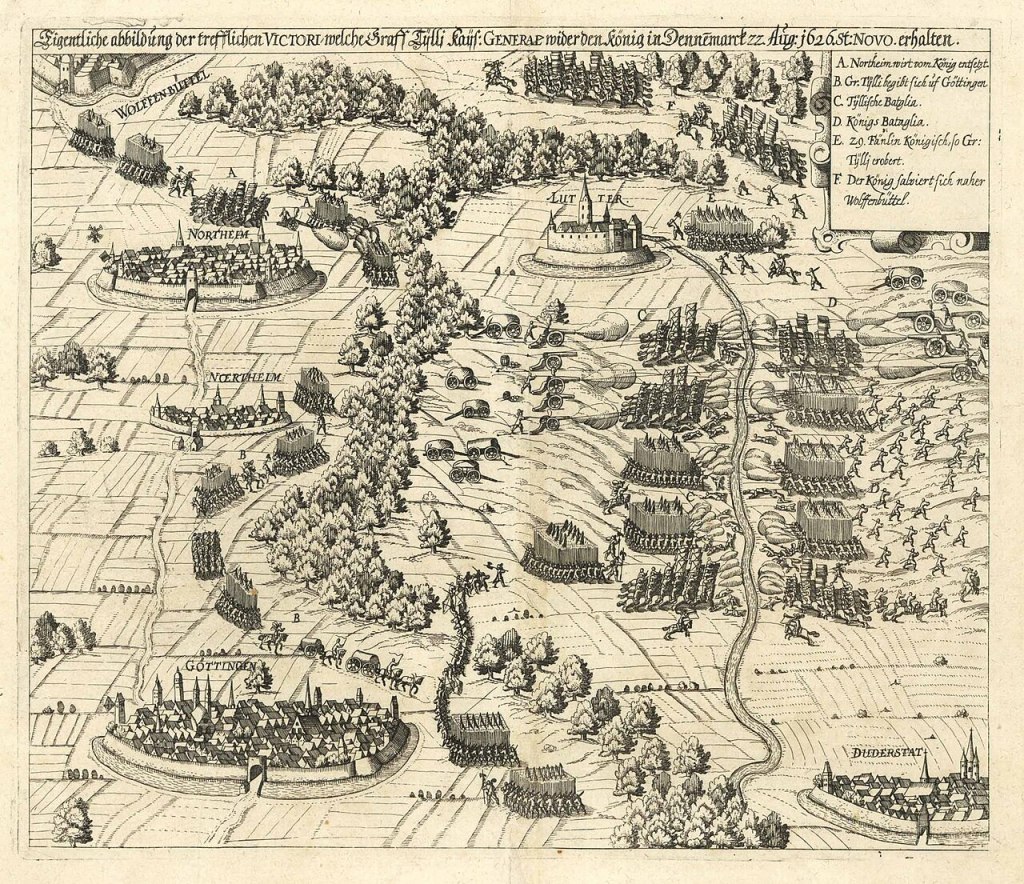
Michael Caspar Lundorp (1580–1629)
Mansfeld was indeed a Catholic all his life and something of an exception in these very religiously motivated wars, in being willing to serve the Protestant cause. He began his military service under Archduke Leopold V of Austria, younger brother of Emperor Ferdinand II. But a real or imagined slight turned him against the House of Habsburg and the rest of his career was in service of the ant-Habsburg Protestant cause. His second-cousin Philipp, Graf von Mansfeld-Vorderort had been serving under Mansfeld as a colonel but was captured by Tilly in 1622 at the Battle of Mingolsheim. He eventually defected to the imperial side and served under Wallenstein so it is perhaps not too far fetched to speculate that there might have been some attempt to use his family connection as a means to try and persuade Mansfeld to turn his coat, but that is my speculation and not a historical fact.
There was a Persian embassy to most of the capitals of Western Europe at this time. It was sent by Shah Abbas. Known today as Abbas the Great, who ruled Persian (Iran) and was very ambitious and outward looking. He had sought to modernise Persia and in that cause even recruited two Englishmen, the Shirley brothers, to train his army in modern warfare. Robert married a Persian noblewoman and the two of them had made a major embassy around Europe a few years before. But this new embassy was sent with a specifically mercantile purpose. Abbas wanted to establish direct trade with the West for the products of his country – especially silk – in a market dominated by his enemy the Ottoman Empire.
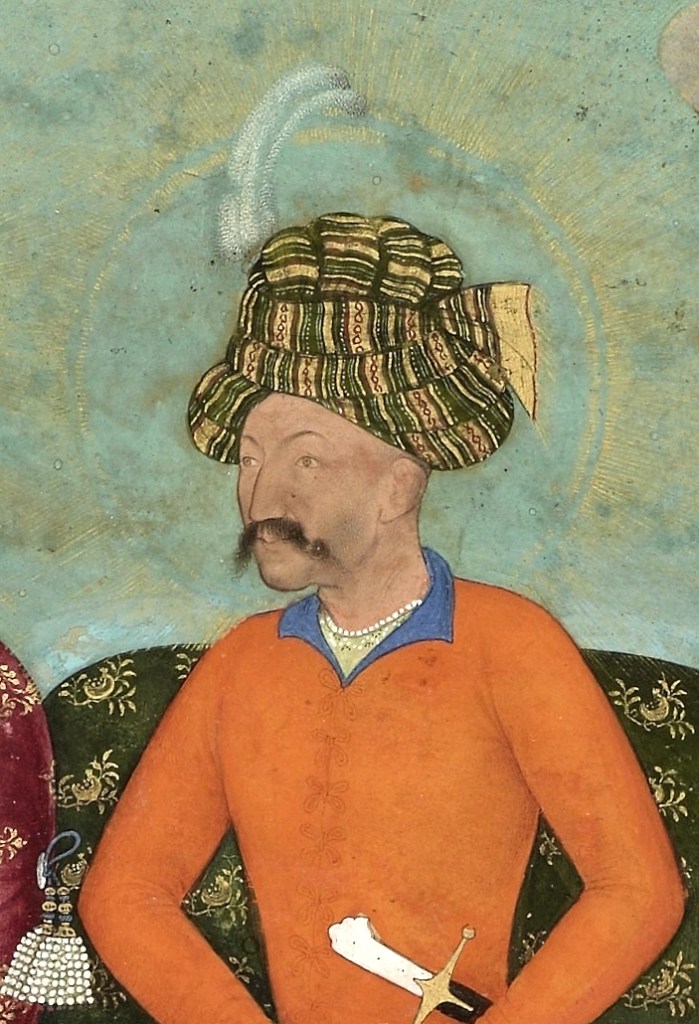
Whilst in the Dutch republic, as well as visiting the Stadtholder, the Prince of Orange, the embassy also paid respects to the exiled Frederick and Elizabeth. This was a matter of great importance to them. Elizabeth in particular made a point of claiming social precedence over the Prince of Orange and his wife, who had once been one of her own ladies. There were even awkward and embarrassing social scuffles between them now and then. From Elizabeth’s perspective this was not arrogance and vanity, she saw it as essential to maintain recognition of her status. If she was no longer regarded as Queen of Bohemia and Electress Palatine, then her cause was as good as lost. But it was increasingly difficult to maintain that regal dignity when living on the goodwill donations of family and friends. Hence any high status gifts would have been treasured and put to good use in upholding appearance.
Christian of Brunswick’s brother, Friedrich Urlich, was an alcoholic and an inept ruler. His relationship with his wife was poor and he tried to divorce her. After his death she went on to found the Anna-Sophianeum Latin School in Schöningen which still exists as a regular high school today. Christian was indeed interred in the Fürstengruft of Hauptkirche Beatae Mariae Virginis in Wolfenbüttel. If you are ever in the area you can take a guided tour of the Guelph crypt and visit his tomb there.
Walter Montagu was a real individual whose exploits seem a bit akin to those of a 17th Century James Bond. He was much involved in diplomatic, espionage and subversive activities in France and at this time was seeking to stir rebellion there as England was at war with France.
Gaston, d’Orleans was a thorn in his brother’s side. At this time he was eighteen and the sole male heir to King Louis XIII. He seemed to delight in rebellion and secure in his own immunity from execution, careless of the fact that the men he incited in his cause would inevitably pay with their lives. However, whatever his faults I have no knowledge of his predilections in his youth, so please note that those, together with the fierce Jeanne, are entirely my invention.
Finally a word, as promised, about Karlo Kadlec.
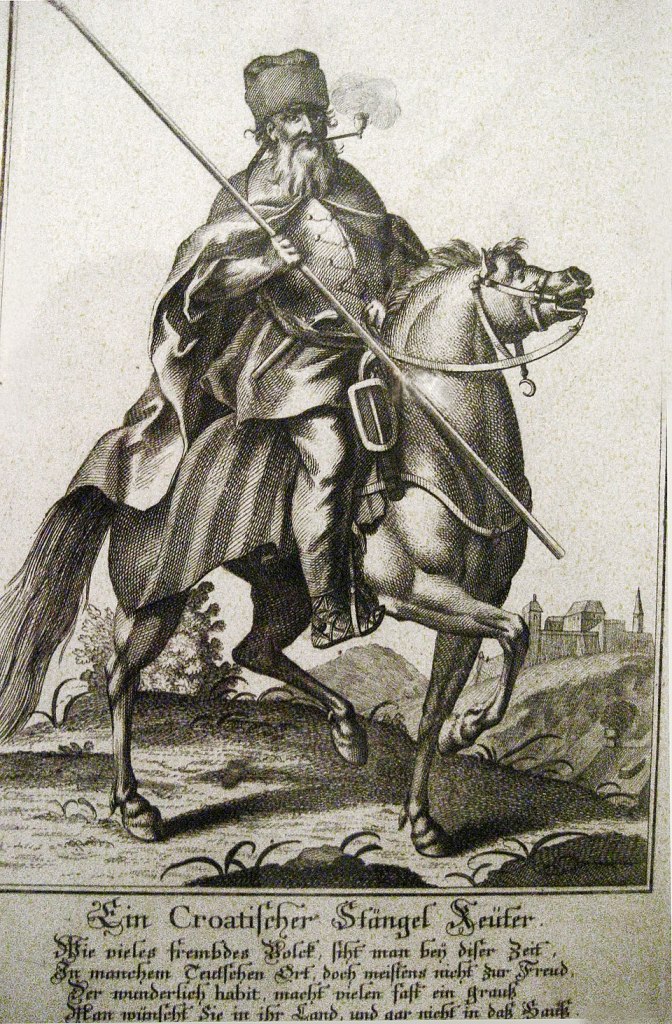
via Wikimedia Commons
Those who have read with John Aubery’s Brief lives may be familiar with this entry:
Captain Carlo Fantom, a Croatian, spake 13 languages; was a Captain under the Earle of Essex. He was very quarrelsome and a great Ravisher. He left the Parliament Party, and went to the King Ch. the first at Oxford, where he was hanged for Ravishing.
Sd. he, I care not for your Cause: I come to fight for your halfe-crowne, and your handsome woemen: my father was a R. Catholiq; and so was my grandfather. I have fought for the Christians against the Turkes; and for the Turkes against the Christians.
Sir Robert Pye was his Colonel, who shot at him for not returning a horse that he tooke away before the Regiment. This was donne in a field near Bedford, where the Army then was, as they were marching to the relief of Gainsborough. Many are yet living that sawe it. Capt. Hamden was by: The bullets went through his Buff-coat, and Capt. H. sawe his shirt on fire. Capt. Carl. Fantom tooke the Bullets, and sayd he, Sir Rob. Here, take your bullets again. None of the Soldiers would dare to fight with him: they sayd, they would not fight with the Devil.
Edmund Wyld, Esq., was very well acquainted with him, and gave him many a Treat, and at last he prevailed with him so far, towards the knowledge of this secret, that Fantom told him, that the Keepers in their Forests did know a certain herb, which they gave to Children, which made them to be shott- free (they call them Hard-men.)
That is the sum of what is known about Carlo Fantom, I allowed myself the privilege of inventing some of his early history!
 Eleanor Swift-Hook