Some interesting things about the book…

The original, working title, of this book, was The Hare’s Course. Those who speak Czech will understand why!
***
Fachhallenhaus
This kind of house is a variation on the hall house that first appeared in the 13th century and was widely adopted across the North German Plain.
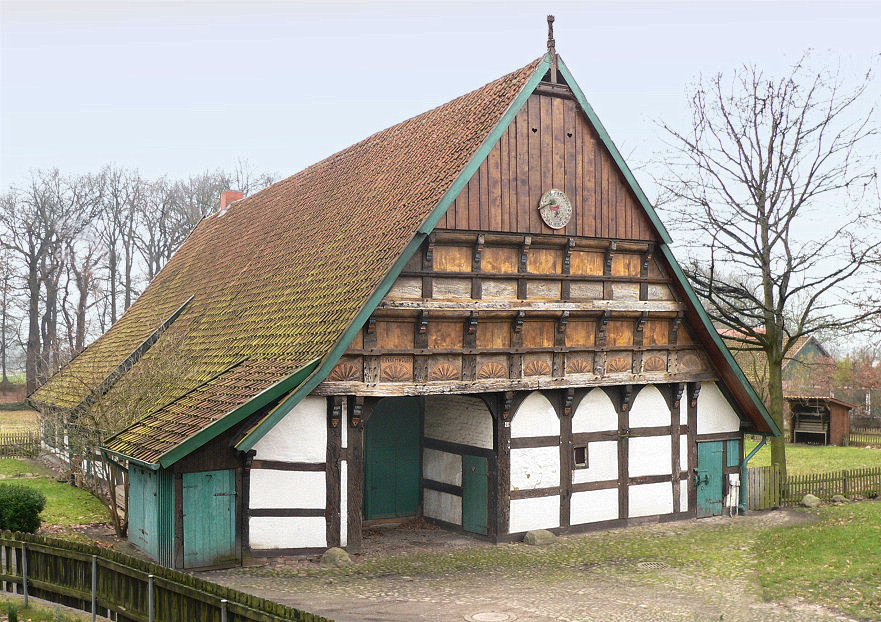
via Wikimedia Commons
It usually had two rows of wooden supports running the length of the house. The Diele was the space between the rows of pillars. This was the main working space of the house, where the harvest would be set out to dry before being stored in the hayloft in the roof above. The Diele would be used for all kinds of tasks, spinning, threshing, maintaining farm equipment – and also for celebrations.
At one end there would be Kübbungen – bays to provide stalls for animals (but not pigs which were banished to an outhouse on account of their smell) and maybe sleeping space for servants and farm workers. At the other would be the Flett, an open kitchen and living space for the family, which might be divided into a separate Stube, with bays or private rooms, though in our period it was often left open.
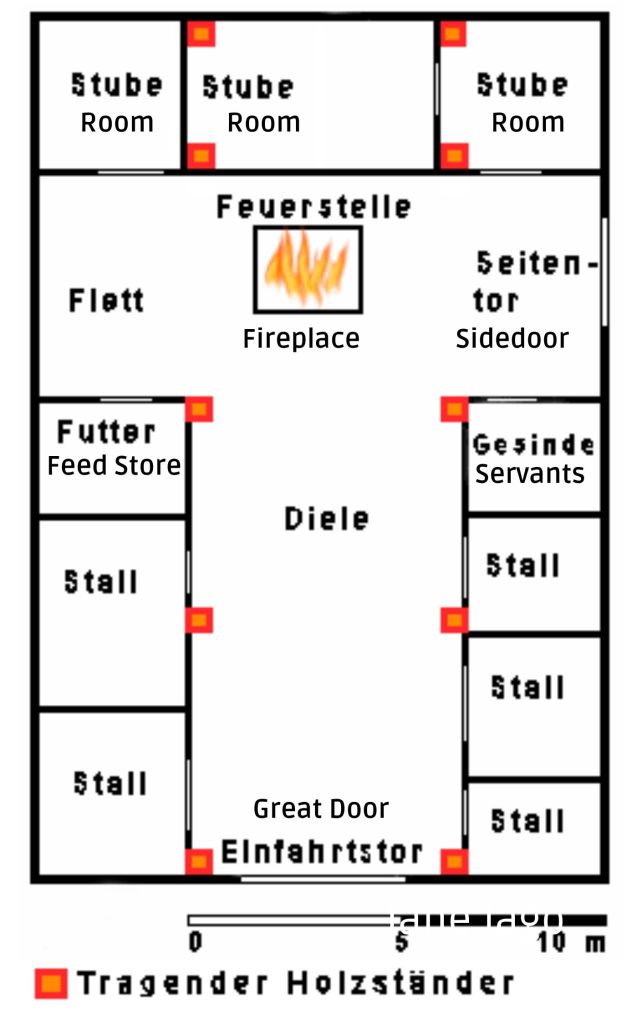
via Wikimedia Commons
The heart of the Flett was the hearth which was an open firepit, surrounded by stones. Cooking would be done in cauldrons hung over the hearth and at night it would be covered with an iron grid to prevent the spread of fire. There was no chimney, the smoke escaping through the Uhlenloch (literally: the owl hole) which was a small opening on the gable. Bread was baked in an outside oven.
The walls were usually wattle and daub filling between the supporting struts, though better off houses might be made of brick and the roof would be thatched with reed. At the animal end of the Diel would be the Grotendör, a huge door, usually large enough to allow a laden wagon bearing the harvest through it. The main entrance for people was a reguar sized side door into the Flett.
***
Masked Balls
Although they would reach their apogee in the 18th century, Masquerade or Masked balls, had their origins in Renaissance Italy. Venice, especially, with its famous Carnival season, though such balls might accompany any grand event from a grand marriage to a diplomatic triumph.
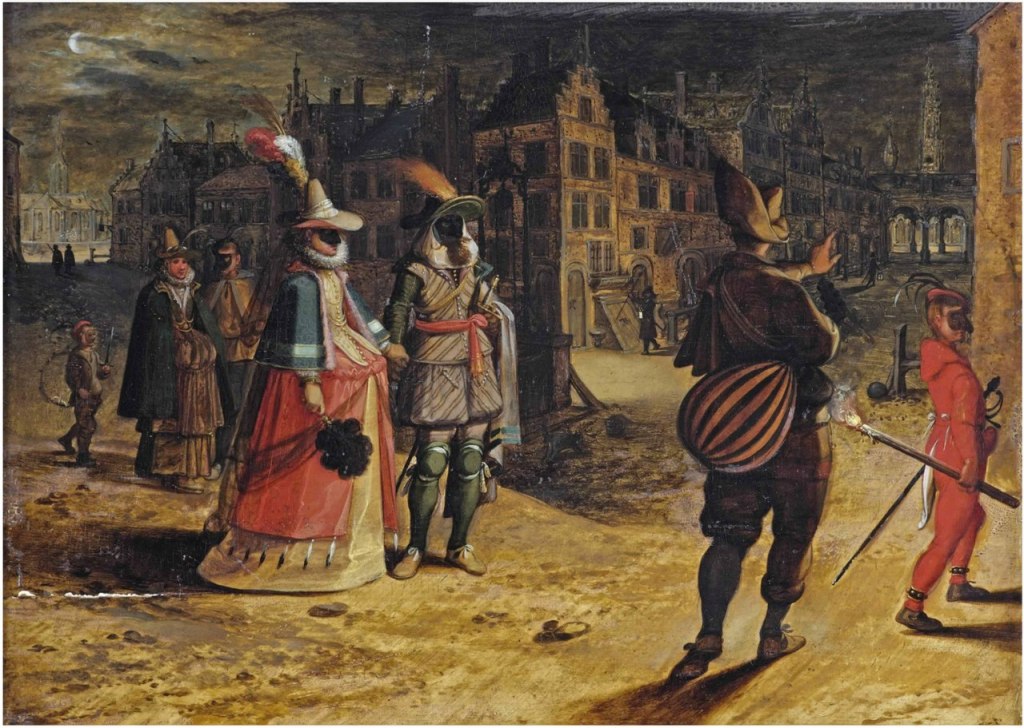
by Sebastiaen Vrancx (1573–1647) via Wikimedia Commons.
The enticing mix of anonymity, and the drama of guessing who was who, held a particular appeal for the wealthy elites for whom anonymity was no doubt a rare experience. The additional attraction for creative displays of wealth offered by the masks themselves, undoubtedly added to the delight.
Masked balls spread from Italy across Europe to find particularly fertile soil in the French court by the late 16th century and were a frequent feature of French courtly events by the 1620s.
***
The Marienkirche in Wolfenbüttel
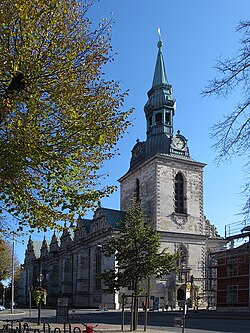
The Hauptkirche Beatae Mariae Virginis was built by Duke Heinrich Julius with the intention of providing a Lutheran High Church for the city and also to create a Fürstengruft, a princely burial vault as a resting place for the ducal family’s dead.
Construction began in 1608 and Heinrich Julius was laid to rest in the new crypt when he died in 1613.
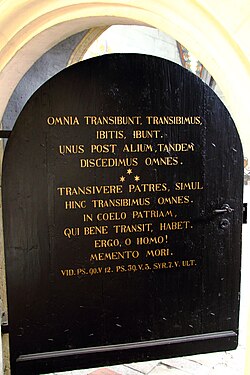
via Wikimedia Commons
It was finished by 1624, but Kate would not have seen the baroque spire on her visit as that was not added until 1751.
The church, designed by Paul Francke (1537-1615), is in a blend of architectural styles, creating a unique final effect was part of the German Mannerism movement.
You can get a glimpse of the crypt in this short YouTube video.
 Eleanor Swift-Hook