
Those who have read The Devil’s Command will already be aware of how Danny Bristow learned his swordsmanship, but the fact there was what amounted to a fighters’ guild in early modern England is not something that is generally known.
A guild of weapon masters is more something you think of when you consider fantasy fiction than real history.
At some point in 1540, we don’t know exactly when because the original documents have been lost, King Henry VIII set one up and gave it powers to root out any unlicensed schools in weapons training, powers which King James I & VI reconfirmed in 1604.
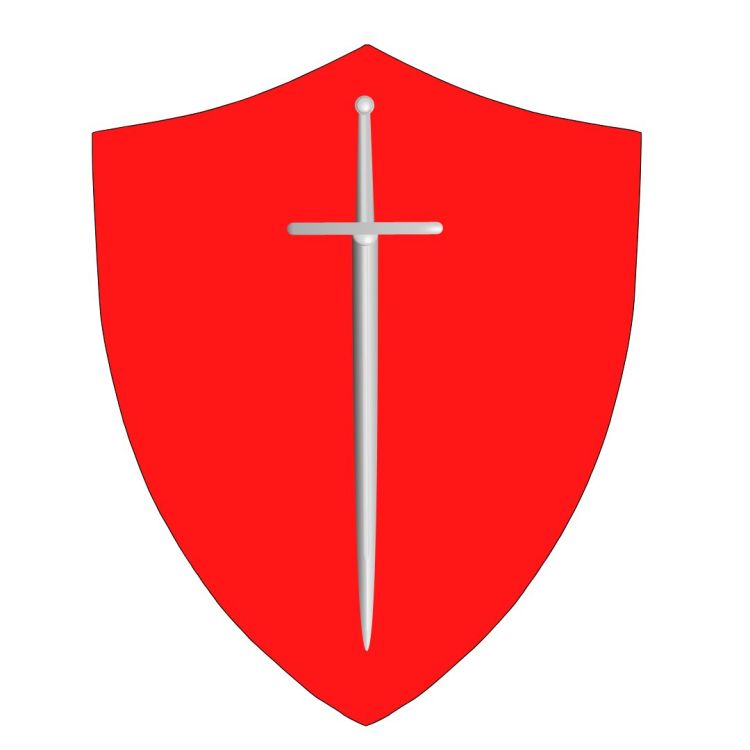
To be technical, it was never a guild; it was a corporation called the Company of Maisters of the Science of Defence. However, in every way that really mattered it operated much as a guild might. It even had its own coat of arms of a downward-pointing silver sword on a red background.
In charge were four grandly named Ancient Masters. Each school was under the control of its own Master, with a Provost or two to assist in the work of education of the scholars.
Scholars were regular students who paid for their lessons. Most of these had no intention of making it into a career. They might be learning for self-defence, much as today we take up a martial art like karate or kickboxing, or because it was fashionable. In Tudor and early Stuart times being able to use a sword to some degree was a required skill for any man with pretensions to even the slightest social standing.
But for a few who started out as scholars, it was just the first step to their chosen career. Admission to the Maisters wasn’t easy and even wealth couldn’t guarantee advancement (although this did waver as time went on). In order to join the company one first had to earn the status of a Free Scholar. These were part of the company structure and the equivalent of apprentices, rather than regular pay-by-the-lesson students. They were there to train to become weapons masters themselves and perhaps one day hold the coveted rank of Ancient Master.
To qualify for any advancement within the company from one rank to the next, an individual had to ‘play for the prize’. This was an event which usually took place over two days and the aspirant had to fight against opponents of their own degree. Sometimes this could require over twenty combats. These provings, especially for the higher ranks, would be open to the public and provided both a spectacle for the paying public and effective advertising for the specific Master and his school, as well as for the company as a whole.

Datei:Chr Neyffer L Ditzinger Collegium Illustre Radierung 1606 Inv.1086.jpg. In Wikipedia.
To become a Free Scholar the aspirant had to be able to fight with both longsword and backsword (a backsword was a sword with only one sharp edge). If he was defeated then he would have to continue as a scholar, but if he prevailed he would be on the bottom step of a lifetime career in weapons mastery.
The title might imply that there was no charge for holding the place of a Free Scholar, but as with any formal apprenticeship, money changed hands between the master and the apprentice or his sponsors (usually his family) to cover the costs of his education. However from then on, unlike regular scholars who were expected to pay a charge for their lessons, the Free Scholars did not. They were instead expected to begin to support the work of their Master in helping to train the regular scholars whilst learning themselves.
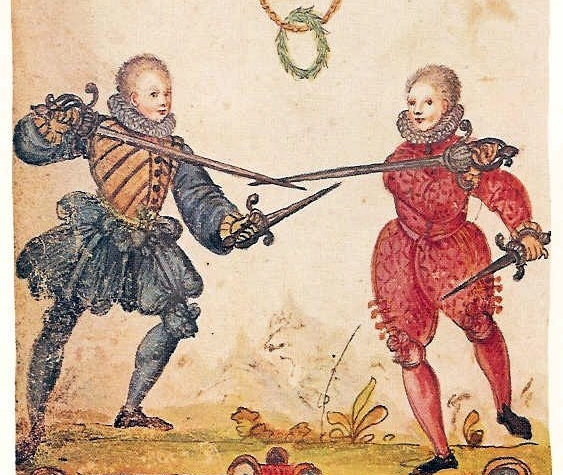
Having qualified as a Free Scholar the individual had to wait seven years (the standard amount of time for any apprenticeship) before they could again play for the prize. A would-be provost had to show his proficiency by fighting existing provosts with a two-handed sword, a backsword and a staff. As a Provost, he would then be bound by an oath not to kill any opponent in a training or proving bout unless to avoid bodily harm or death himself. The Provost would be like a journeyman in a trade guild, assisting the work of his master in teaching the scholars and free scholars whilst improving his own techniques. If demand was high enough, permission could be granted for Provosts to establish their own schools whilst still under their Master’s authority.
Public domain, via Wikimedia Commons
To become a Master, a Provost needed to be able to fight with four different sword types, including the rapier, as well as with a pike, and a dagger. The trial to become a Master would be a major event with paying public attending in large numbers to see someone playing for the prize. They would be held in theatres or in the yards of inns where plays were often put on.
Once confirmed in his new status a Master was free to set up his own school according to the rules of the company. But these said nothing much about how the school would be run on a day-to-day basis, that and its organisation was left to the Master to decide for himself.
So why did the Maisters of the Science of Defence decline and fade from sight in the first decades of the 17th Century?
As yet historians have no definitive answer. We don’t know when the company formally wound up its affairs or indeed if it ever did so. But it was no longer around as a notable entity by the end of the 1620s.
It has been suggested that the sword-fighting methods the Maisters insisted on teaching were restricted and hidebound. However, that charge doesn’t really stand up to scrutiny. There was no restriction on how a Master might teach in his school, no set syllabus or form. Training in the necessary weapons could be according to the latest styles and would have been updated with each new generation of Masters.

Girard Thibault, Public domain, via Wikimedia Commons
In my opinion, two causes seem likely to account for its demise.
Firstly was the fact that Maisters didn’t have the necessary noble patronage. All through their recorded existence even the Ancient Masters were men who would be accounted at best gentlemen and were mostly yeoman. The sons of nobility or wealthy gentry would take private lessons with a Master and have no need to enter the schools in a regular way as students. That meant that the Maisters had little real power backing them up to enforce the exclusive licence they held.
Towards the end of the 16th century, there was a rise in fencing schools run by foreign swordsmen, men like Vincento Saviolo, focusing almost exclusively on the rapier, increasingly in vogue as a gentleman’s weapon of choice. These were usually not under the authority of the Maisters. Without the force majeure of powerful backers in the nobility, the Maisters could do nothing to prevent these fashionable schools from multiplying, especially when it was the nobility who preferred to frequent the trendy new schools.
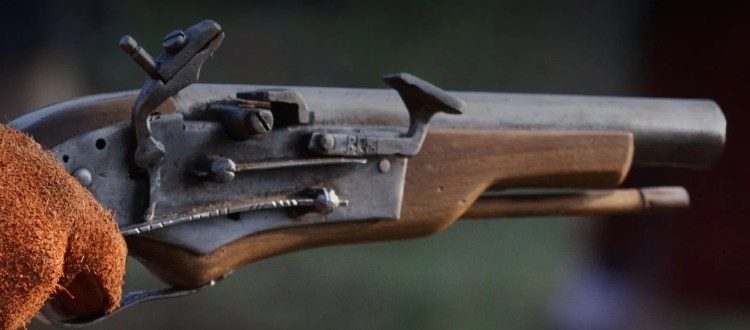
But human competition was not the only problem the Maisters confronted. They were also suffering increasingly from the unstoppable onset of new technology.
As Danny Bristow says in The Devil’s Command: “A man with less than an hour of training to use one of these can defeat the best swordsman in the world.”
To be sure not to miss out on news about my current projects, you can sign up for my newsletter here and receive a free Lord’s Legacy short story.
(The first image is Le Duel a l’Épée et au Poignard (The Duel with the Sword and Dagger), from Les Caprices Series A, The Florence Set 1617 by Jacques Callot , CC0, via Wikimedia Commons)


,_from_Les_Caprices_Series_A,_The_Florence_Set_MET_DP874422.jpg)
Great article, I’d no idea such a thing even existed.
LikeLiked by 1 person