Historical Background to The Alchemist’s Plot

Queen Henrietta Maria courageously endured the sea crossing as described in the book, and her landing at Bridlington Bay, together with the subsequent attack, is very close to my interpretation of it.

Anthony van Dyck , Public domain, via Wikimedia Commons
Sir John Hotham asked for precisely the things I mention to switch sides, but his offer was made through the Earl of Newcastle. Later that year he and his father’s wavering loyalty was to lead to their arrest and execution by Parliament.
The Royal Tapestry Works at Mortlake produced work seen as amongst the very finest such in the world for that era. The house that had previously belonged to Dr John Dee and was the subject of an ongoing land ownership dispute. Records point to the house (or perhaps more accurately interconnected houses) being both workshop and home to the Dutch and Flemish weavers who produced the tapestries.
Francis Cleyn was indeed poached from the Danish court, and he provided the design for the tapestries. Near the start of the war, Cleyn moved to Oxford and produced several portraits there. I could not find any information regarding his wife, so the suggestion of a familial link with the de Maechts is not historical, though Cleyn did have daughters called Magdalen and Penelope, who went on to become painters themselves.

George Vertue , Public domain, via Wikimedia Commons
I have done my best to be accurate in presenting London and its environs as it was at the time. Places such as Holland’s Leaguer and the Manor in the Maze were real and much as I have described.
Whilst The Crown and its location is my invention, Hanging Sword Alley did and does exist. The story of how it got its name is as I have described.
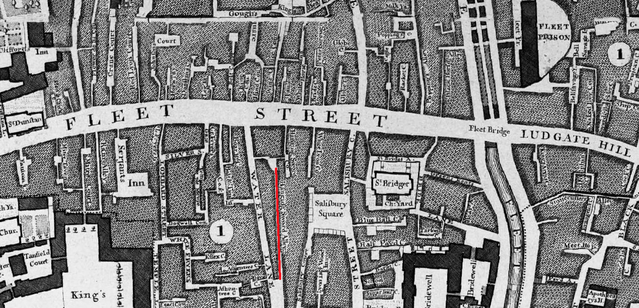
The liberty of Whitefriars had been renamed Alsatia after the province of Alsace, devastated in the Thirty Years War, because it was such a lawless slum. Its charter granted by King James in 1608 was opaque and left it both largely self-governing and with the archaic right of sanctuary which had belonged to the Carmelite monastery. As a result, it became a haven for debtors and other criminals.
John Dee was a controversial character in his lifetime and ever after. He is a fascinating historical figure. If you have the time and inclination, I recommend picking up one of the more recent available biographies about him.

Unidentified painter , Public domain, via Wikimedia Commons
He was much concerned with the idea of an empire centred on Britain and his religious inclinations seem to have been very flexible, more driven by his idea of direct communication and revelation than by following any specific creed. Indeed, he was to face accusations of heresy on and off throughout his life. He was also a great mathematician and cryptographer, involved himself in experiments, studied astronomy as well as astrology and, like Isaac Newton a century later, saw no hard line between science and the spiritual.
He believed he communicated with angels and spirits. However, he couldn’t see them himself. For this he relied upon Edward Kelley, a rather dubious individual with whom Dee had an often stormy relationship.
 Eleanor Swift-Hook

_by_George_Vertue.jpg)
