Some interesting things about the book…

The original, working title, of this book, was The Fox’s Cunning.
***
The tapestries produced in the Mortlake Tapestry works were amongst the very finest being produced in all of Western Europe at this time. This example was made in the 1630s and designed by Francis Cleyn.
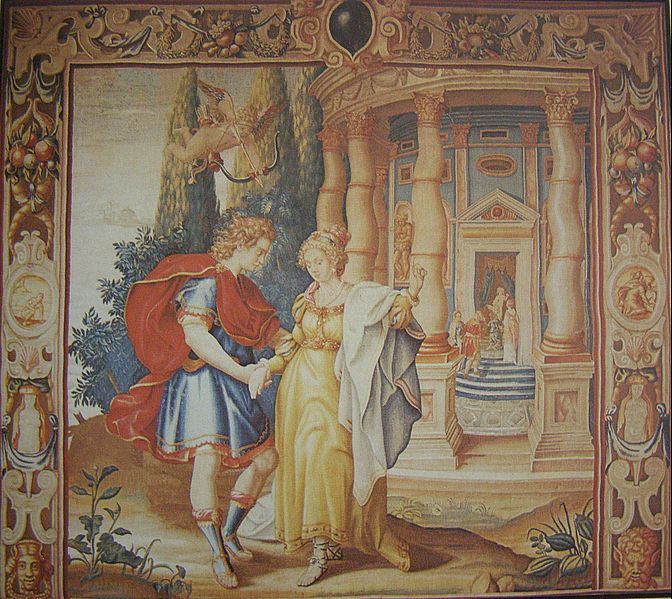
Francis Cleyn , CC BY-SA 3.0, via Wikimedia Commons
Weaving of the tapestries was done on a haute-lisse loom, a large, vertical loom which had advantages over the more common basse-lisse horizontal loom. The tapestry would be woven as it would be hung and the tapissier did not need to rely on a mirror so much as he could walk around to the front of the tapestry to see how it looked as he progressed. It was also easier on the back as it involved less bending. At the time it was generally agreed the very best tapestries were woven on the haute-lisse.
This is a modern example of a haut-lisse loom from the Gobelin Tapestry Works in France where tapestries are still produced using 17th Century methods.

No machine-readable author provided. David.Monniaux assumed (based on copyright claims)., CC BY-SA 3.0, via Wikimedia Commons
***
John Dee’s book Monas Hieroglyphica is an exposition upon the meaning of the symbol of that name which he invented. The text is pretty obscure and there is much debate as to what exactly Dee thought his monad to be. There have been claims it is purely alchemical, or that it is in fact a blind and the book is in fact a work on cryptography. The symbol combines the astrological and alchemical symbols of the moon, the sun, the four elements (fire, air, water, earth) and Aries. But the symbols for Mercury, Venus, Jupiter, Saturn and Mars can all be picked out as being represented in it as well as can other symbols.
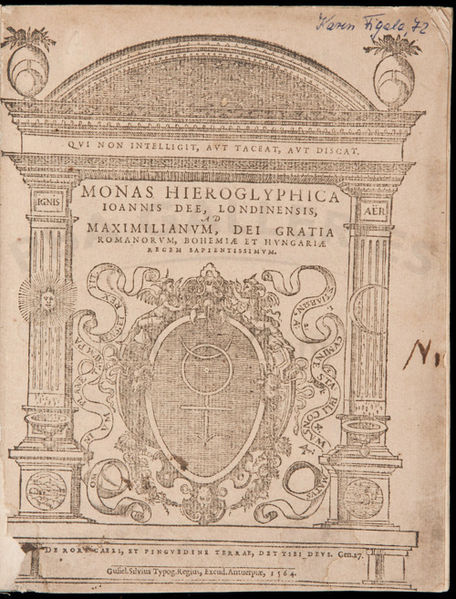
John Dee, Public domain, via Wikimedia Commons
The complete text is widely available both online and in published form if you wish to examine it for yourself.
The monas symbol was adopted by whoever wrote the Rosicrucian pamphlets and appears in the third of the original manifestos the Chymical Wedding of Christian Rosenkreutz.
***
This is the sketch that Francis Cleyn gives to Philip Lord

 Eleanor Swift-Hook


