Some interesting things about the book…

The Devil’s Command is the only book in the series to be published under its original title.
***
Piquet
Piquet is a card game that first appeared in the Sixteenth Century but spread across Europe in the Thirty Years War. It is still played today, though the rules by which it is played have no doubt evolved over time and variants exist. I have found several different versions of the rules and variations on those differing versions, so rather than go into great detail I’ll give a broad outline of the game here.
It is a game is played with thirty-two cards (7 to Ace in all four suits) by two players who are referred to as the ‘elder’ and the ‘younger’. The younger is the dealer and the deal alternates through the six hands that make a full game or partie.
Once twelve cards are dealt to each player, the elder can take up to five cards from the talon pile of undealt cards. Then the younger can take what remains.
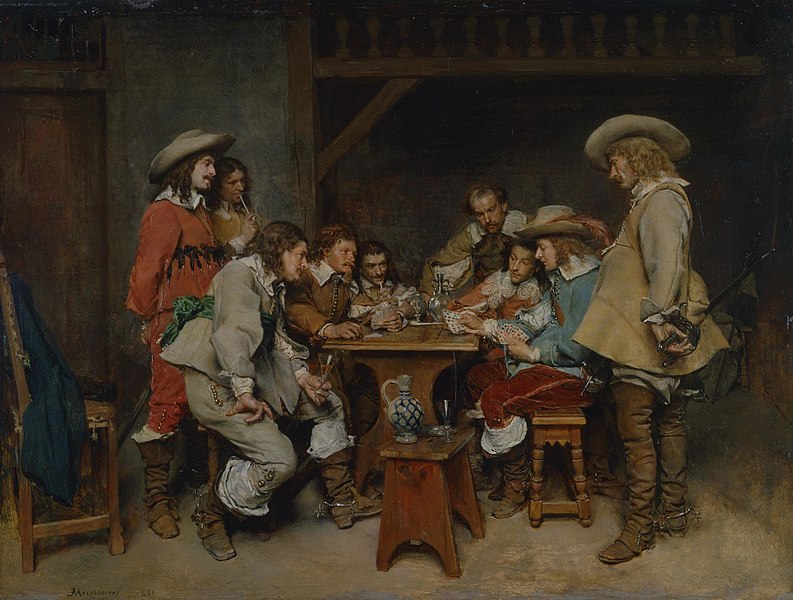
Jean-Louis-Ernest Meissonier, Public domain, via Wikimedia Commons
The play favours the elder and consists of two phases: the declarations, when each player claims for the number of cards (three or more) in one suit, sequences (cards in order), and sets (three or four of a kind). If the younger can’t best the declaration of the elder they say ‘Good’ if they can they say ‘Not good’ and follow it with their own declaration. Or they can say ‘Equal’. Points are scored on the declarations.
Then the game is played out and points are scored for tricks won. There are no trumps so the highest card in the suit led wins the trick.
There are many other refinements, such as a hand with no honour cards in it scoring a few points as a sort of consolation prize if declared. And then there is pique, when the elder scores 30 points in declarations and play before the younger can score any and gets an additional 30 points for doing so. Repique is a similar award, when either player scores 30 points before the other scores any.
The winner is usually either the first to 100 points or the highest score at the end of a parties.
***
The Company of Maisters of the Science of Defence.

This was a historical institution – a ‘fighters guild’ established by Henry VIII and still active enough to have its privileges reconfirmed by King James I & VI in 1604.
If you would like to find out more about it you can read my blog post on the topic: The Fighters’ Guild of Merry England.
 Eleanor Swift-Hook
